
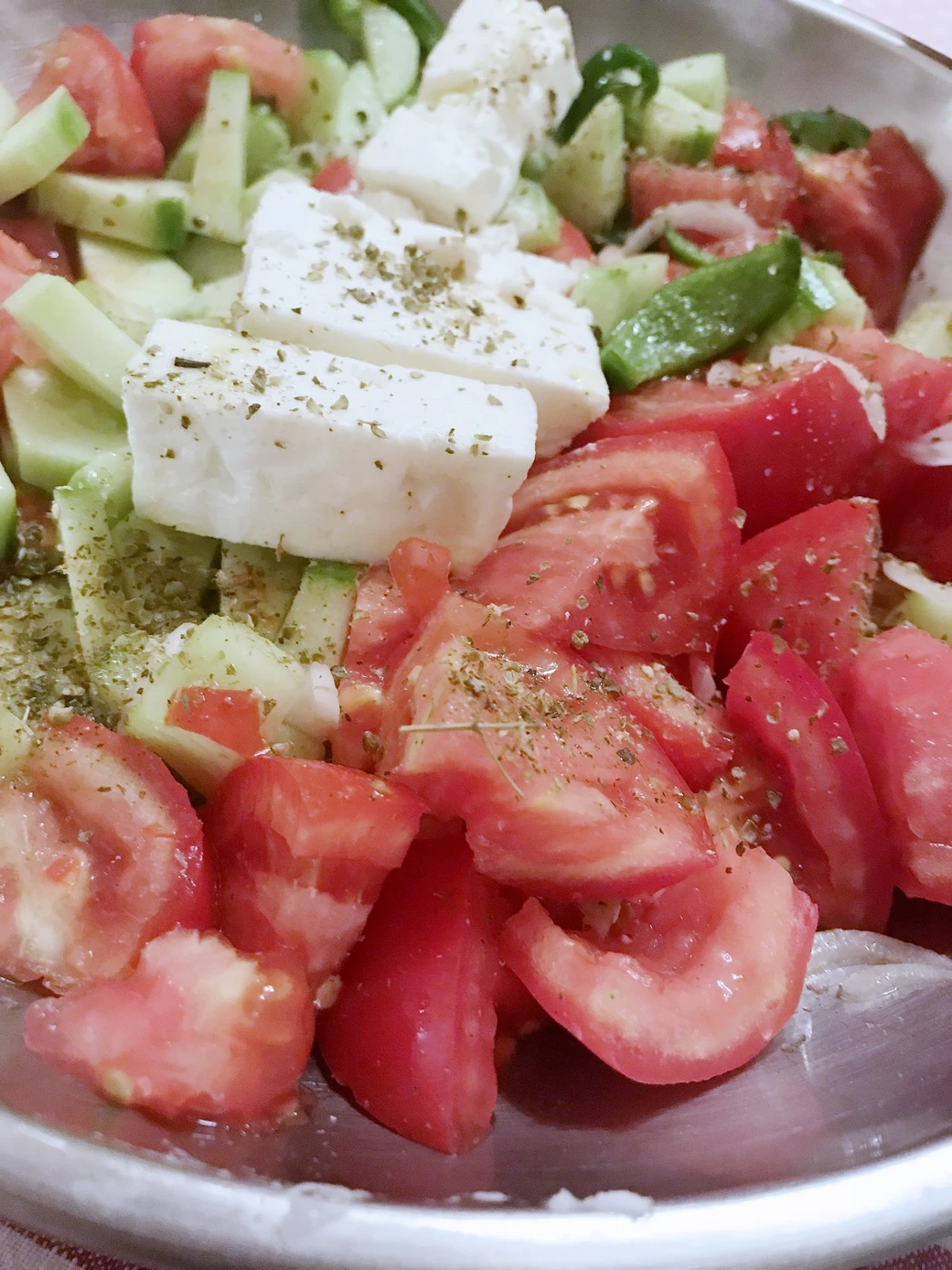
(Hint: It’s Not Lettuce!)
When planning your visit to Greece, it’s helpful to get acquainted with the local cuisine, and a staple there is the Village Greek Salad. While you may think you know what to expect, there are a few surprising twists to the classics.
Most travelers arrive dreaming of spinach pie, lamb gyros, and Greek salads—but the authentic versions of these dishes might not look quite like the ones you’re used to back home.
For starters, gyros in Greece are typically made with pork, not lamb. The beloved spinach pie (spanakopita) is indeed popular, but more often, you’ll find locals enjoying tiropita (a rich cheese pie) or hortopita (filled with a variety of wild greens). And that “Greek salad” you know? It’s probably not Greek at all.
In the U.S., a salad almost always means a bowl of leafy greens—often with lettuce as the base, topped with olives, feta, peppers, beets, chicken, and a vinaigrette. But in Greece, a traditional Greek salad—called Horiatiki—contains absolutely no lettuce.
Why? Simple: lettuce is a cool-weather crop, and with Crete’s hot, sun-drenched climate, it’s not commonly grown or eaten.
The real-deal Horiatiki (Village Greek Salad) is made with:
- Ripe tomatoes
- Crisp cucumbers
- Green bell peppers
- Thinly sliced red onion
- Kalamata olives
- A thick slice or chunks of creamy feta

It’s dressed with nothing more than sea salt, dried oregano, and a generous drizzle of high-quality extra virgin olive oil. That’s it. No lettuce. No dressing. No frills. Just fresh, sun-ripened ingredients in perfect balance. And trust me—it’s divine.
Whenever I visit Greece, I find myself eating this salad almost daily. There’s something about the flavor of the vegetables there—the sweetness of the tomatoes, the briny olives, the sharpness of the onion—that’s nearly impossible to replicate at home. Maybe it’s the soil, the sun, or the slower pace of life that makes everything taste better.
Still, I encourage you to try making it yourself. If you live somewhere warm, you might come close!
Below is my favorite version of the Horiatiki recipe—straightforward, fresh, and full of flavor.
Embrace the simplicity. Enjoy the tradition. And as we say in Greece, καλή όρεξη (kali orexi)—enjoy your meal!
If you would like to have posts like this delivered directly to your inbox, consider subscribing and each time I publish you will automatically receive the content.
Leave a Reply